

The speed of building now depends on how many agents you can handle.
The models are fast enough. The limit is you: how many agents you can keep moving in parallel without losing track of any of them.
More code, faster, than anyone can read. Skimming is hoping.
Five agents, one pair of eyes. While you read one, the other four wait for you.
"Delete the test file" / "delete the rest of the file." A misheard word executes.
One harness for every agent, every project, every language.
Talk to it, hear it talk back, and let it run the rest, on any model, with git built in.
Real-time talkback while you pace, sketch or make coffee. Ask for a change, hear what happened, answer the next question, without going back to the keyboard.

Give instructions in your own language, or mix two. SKI works out what you meant and hands the agent a precise instruction.
"login वाले tests फिर से चलाओ"
"vuelve a correr los tests de login"
"ログインのテストをもう一度実行して"
Rerun the login test suite
An intelligent orchestration layer keeps the context of every project, branch and chat. Ask where things stand and get one spoken answer, then let it hand each job to the right agent.
Bring the accounts you already pay for and pick the engine per task. When the leaderboard changes, your workflow stays.
Claude Code, Codex, Antigravity and OpenCode side by side, each on its own task. You hear the moment any one of them needs you.
Every chat gets its own branch and worktree, so agents never step on each other. Watch the diff as it happens, then say "open the PR".
"Open the PR."✓ PR #142 opened
You find out what your agents did by listening, not reading.
Results, summaries, the moment something needs you, spoken while you keep working.
One voice command. A chain of agents.
Say who does what. One agent plans, SKI hands its work to the next, and you hear when the whole chain is done.
What you meant is what runs. Anything irreversible asks first.
SKI rebuilds the instruction from your project, shows you the interpretation, and gates anything irreversible.
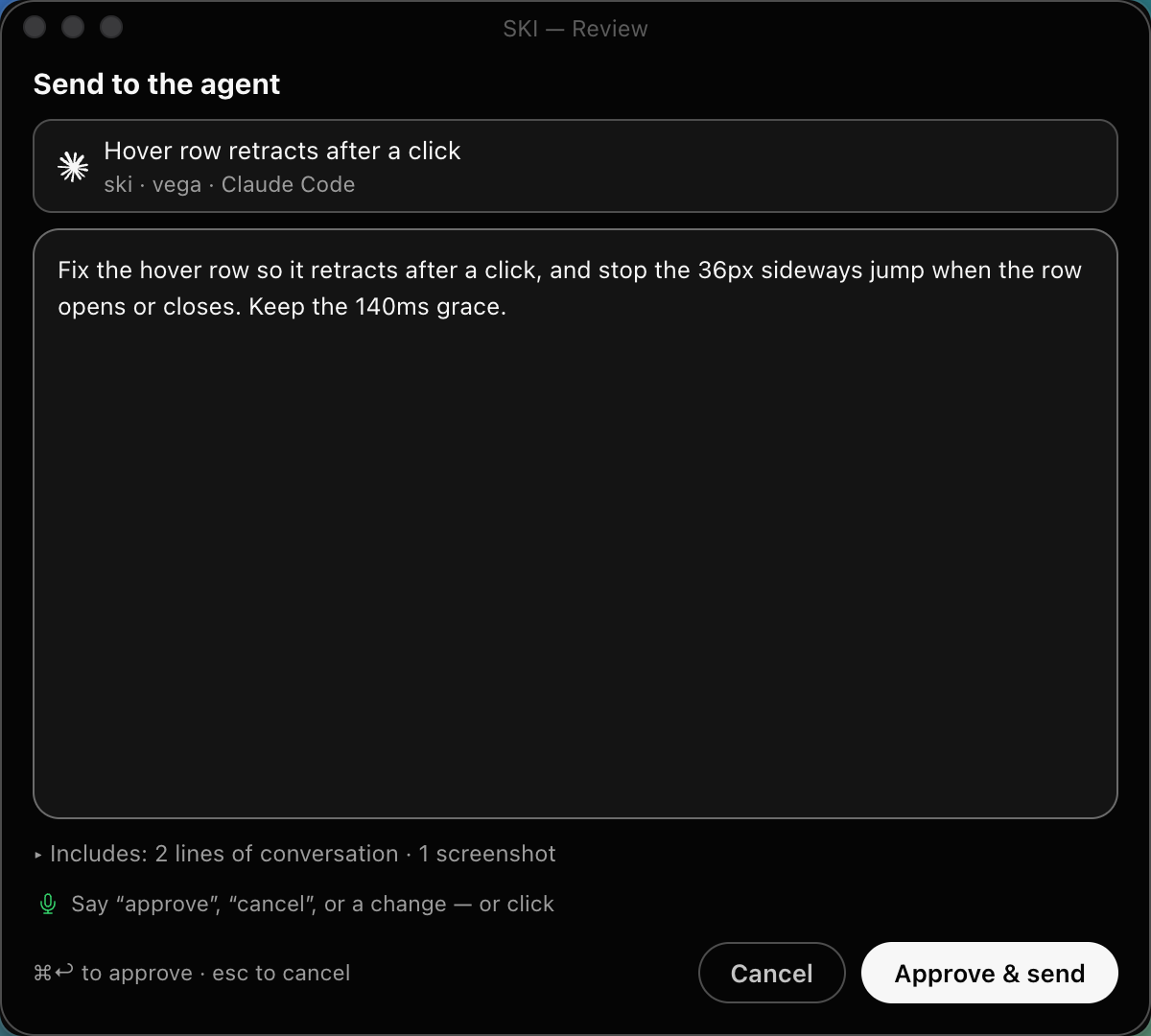
From project context, not raw transcription.
You correct it before the agent ever sees it.
Routine work runs. Destructive work asks.
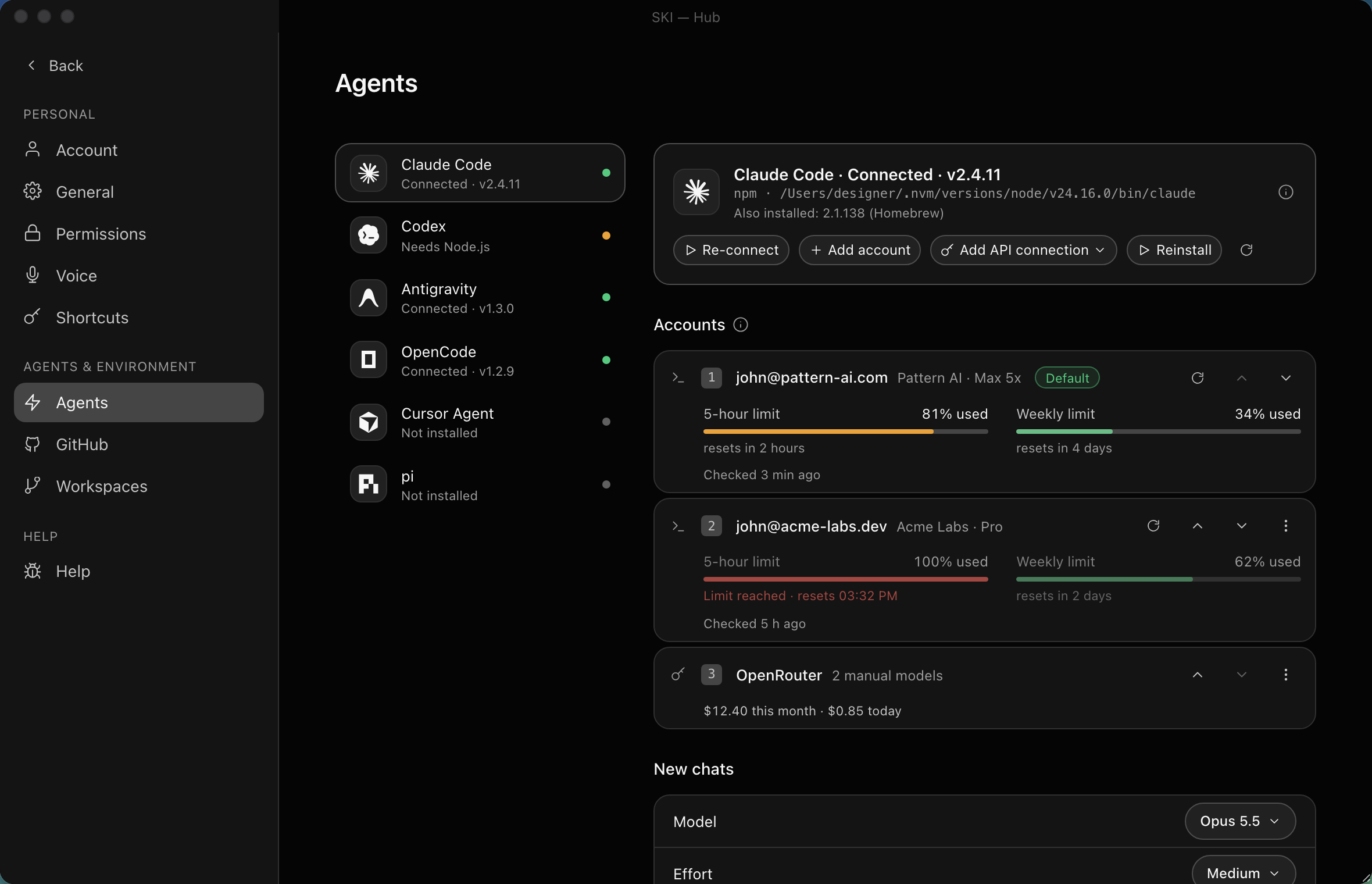
Run every engine you already pay for, and send each job to the right one.
Hard reasoning to the expensive engine, bulk work to a cheap open-weight one. Spend follows the job, not the vendor.
A harness built for typing assumes you are watching the screen.
A reply is expected in ~200 ms; an agent turn runs ~45 s. A fast layer holds the conversation while the slow work runs.
You type composed prompts. You speak messy ones. The harness works out the intent and asks instead of guessing.
Repair is designed in from the start, not bolted on after a bad transcription.
None of this can be retrofitted with a microphone.
Your code stays on your Mac.
Your projects, code and chats stay on your Mac, and your agents run on your own accounts. Your voice goes through the cloud to be understood and answered. It isn't stored.
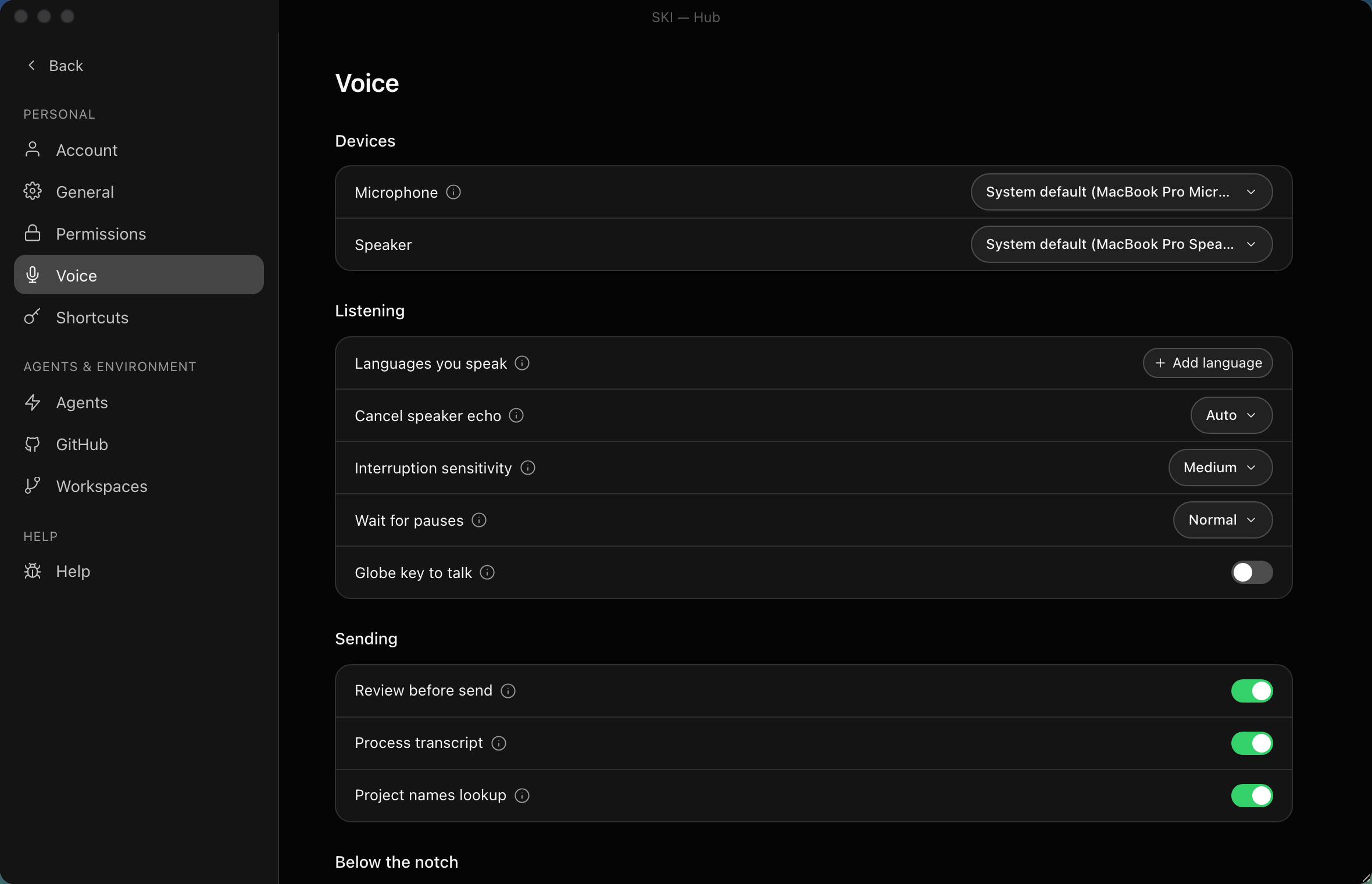
Every agent, every state, on one canvas.
Leads, workers, and what each one is doing right now. You hear the moment any of them needs you.
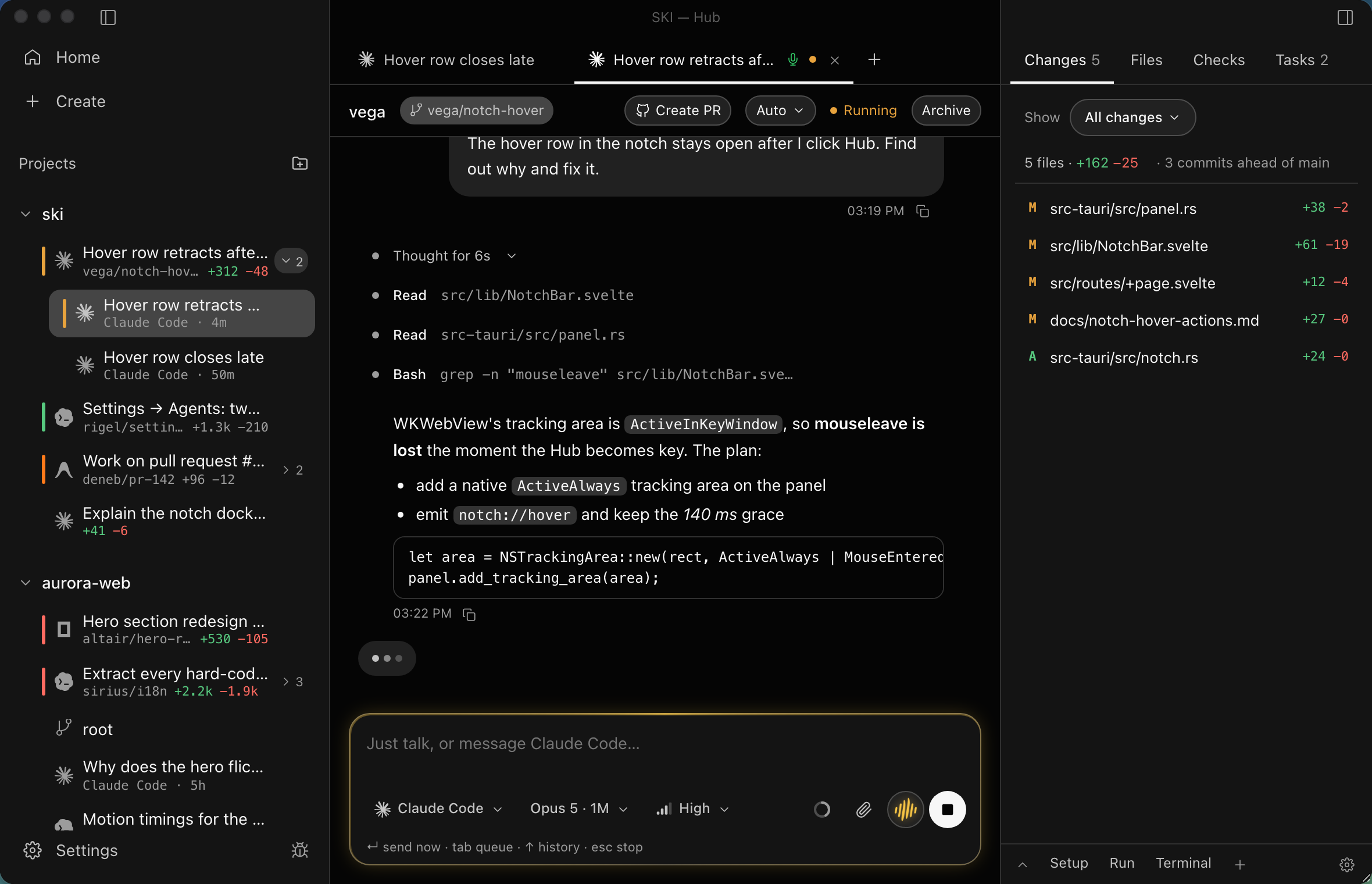
A neutral harness, free forever. You only pay for voice.
SKI is not tied to any model company, and it stays free. Every plan runs every agent with the full voice loop; plans only differ in how much you talk. Pro lets you talk to more agents at once, and Enterprise brings the whole team.
Text is free. Forever.
Everything you can do by typing is unlimited on the Free plan: every agent, every project, git built in. No subscription, no credits, no time limit. Credits only pay for real-time voice, because fast, secure voice costs us to run.
- ∞text chats
- 0credits used
- $0for life
The full harness on your Mac. Good enough to keep, not a crippled trial.
- Unlimited text chats with every agent, free forever
- Every agent you already use: Claude Code, Codex, Cursor, OpenCode, Antigravity and pi
- Talk to your agents and hear them talk back
- The Hub: every project and agent chat in one place
For days when you run a whole team of agents and talk to them all.
- Everything in Free
- Top up any time; top-up credits last 12 months
- Upgrade or cancel in SKI, under Settings, Account
For teams that want SKI on every Mac, at better rates.
- Everything in Pro
- Better rates for the whole team
- Talk to us about what your team needs
Prices in US dollars, plus tax where it applies.See full pricing and FAQ →
Is SKI really free?
Yes. Typing to your agents is free for life: unlimited text chats with every agent, on the Free plan, with no subscription and no credits. Credits and session limits only apply to real-time voice. Pro is for when you want to talk to more agents at once.
Is this dictation?
No. Dictation hands text to somebody else's harness. SKI is the harness: the whole loop runs on voice.
Isn't talking slower than typing?
Often, yes. The win is not the input. It is that you stop reading output and hear the moment an agent is blocked.
How is this different from an orchestrator?
They orchestrate by clicking. Ask any of them: how do you steer an agent when you are not looking at the screen?
Which agents and models does it work with?
Whichever ones you already run. Neutrality is the point.
What happens if it mishears me?
You see the interpretation before it runs, and anything irreversible asks first.
Do I have to talk to a salesperson?
No. Get SKI, install, start.
Pick your platform.
Not out yet. Leave your email and we'll write when it is.
The coding harness you talk to. Run every agent you already use, and hear them, instead of reading them.
Product Hunt#1 Product of the Day